
News
Bayelsa SSG, Prof Ayawei Attends Public Lecture In FUO

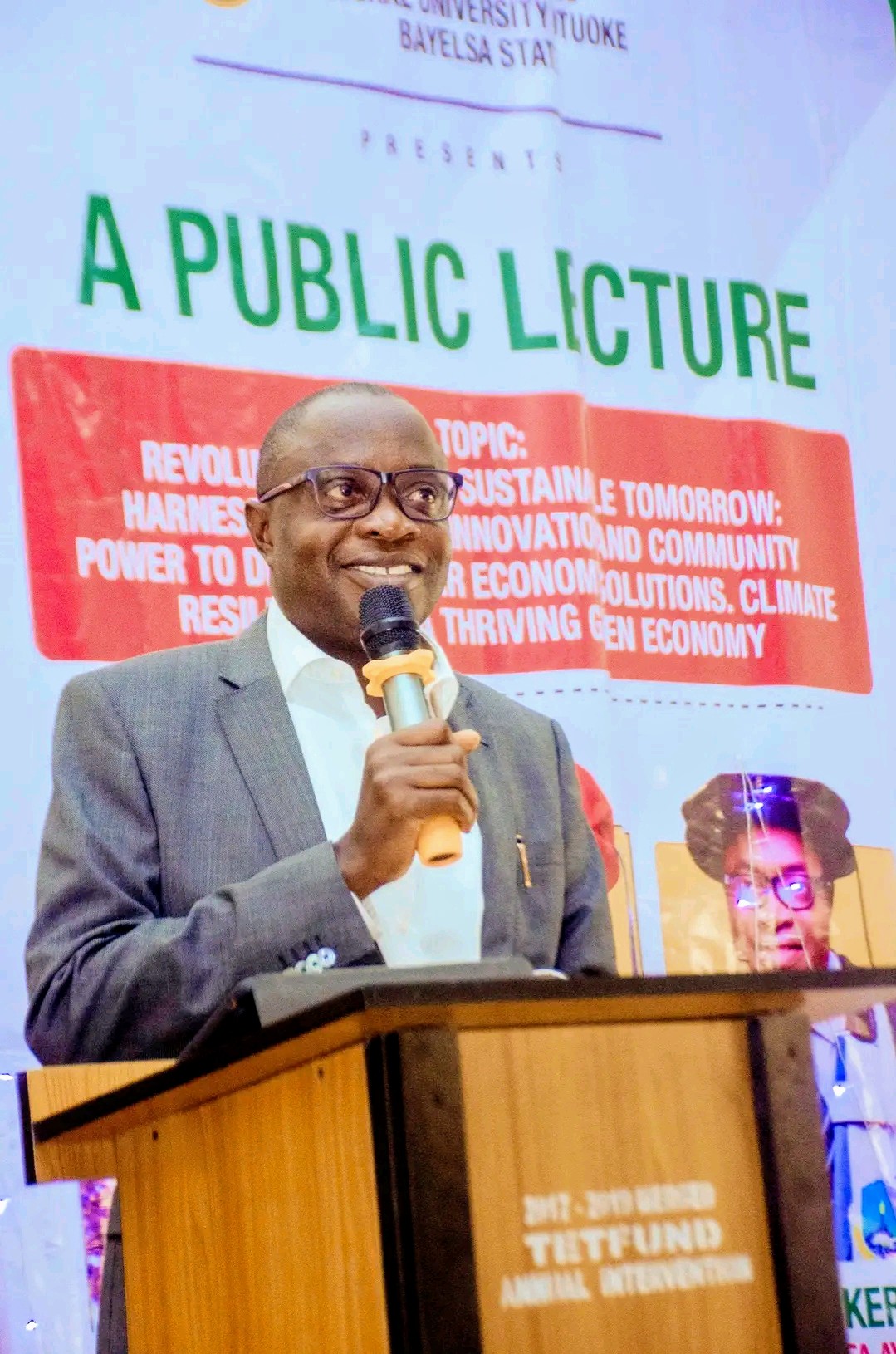
By Preye Bagou, Yenagoa
The Secretary to the Bayelsa State Government, Professor Nimibofa Ayawei, honored the invitation to attend the first International Conference in Federal University, Otuoke, at the Information and Communication Technology (ICT) Hall.
The event organized by the Faculty of Science in the prestigious university, was attended by government functionaries, lecturers, students, scholars and experts in the field of science and technology.
Prof Ayawei made this known through his official facebook handle, described the event as a privilege and honor to deliver keynote address on areas that foregrounds the human existence on planet earth.
The statement read in parts: “I had the honor of delivering a keynote address at the 1st International Conference held at the prestigious Federal University, Otuoke. The event, organized by the Faculty of Science, took place at the ICT Hall, Main Campus, and was a remarkable gathering of students ,scholars and experts in the field.
A KEYNOTE ADDRESS.
Theme:
REVOLUTIONALIZING A SUSTAINABLE TOMMORROW:
HARNESSING SCIENCE, INNOVATION AND COMMUNITY POWER TO DRIVE CIRCULAR ECONOMY SOLUTIONS, CLIMATE RESILIENCE AND A TRIVING GREEN ECONOMY
PROTOCOLS
I consider it a rare priviledge and great honour to be in your midst today to present the Keynote Address on a theme that is pervasive and foregrounds our existence as humans on Planet Earth. I salute the ingenuity of the Vice Chancellor, Management of the Faculty of Science and indeed the entire university community for provoking our thoughts on the overriding need to revolutionize our tomorrow by recognizing the place of science, innovation and community power in our quest for improved livelihood without compromising our future.
In the distant past, Planet Earth was a safe haven: a thriving paradise where nature flourished; where the air we breathe was pure and fresh; where the oceans offered a home for aquatic life; where the water we drank was free of contamination; where the rivers, creeks and rivulets ran unhindered and devoid of wastes and contaminants; and where the entire ecosystem was in symmetry with the course of nature.
Today, a different tale exists.The once smiling and animated earth is confronted with the realities of a man- induced precarious existence. Industrialization, technology and the increasing search for development have given rise to deforestation, pollution, rising temperatures, extreme weather conditions, resource depletion, perennial floods, increased heat waves and various forms of environmental degradation. A gloomy future beckons and an existential threat looms in the horizon.
Solutions to the problems have been enmeshed in idealized rhetoric, throwing up more discussions and conferences than concrete action. We have to move out of the idealizations that the existing rhetoric presents to a more pragmatic approach, where our thoughts and actions are revolutionalized to take bold and transformative steps to re-write a new history of tomorrow that is founded on prosperity and sustainability.
CONCEPTUAL ANTECEDENTS
The Vice Chancellor, Distinguished Ladies and Gentlemen, permit to say that the idea of sustainability is rooted in the theories of creation, which later aroused global sensibilities to chart a course of action to safeguard the planet earth from inevitable extinction.
Biblical Account of Creation
The Biblical account of creation as contained in the Book of Genesis Chapter 1 provides a spiritual foundation for sustainability. It explains the original nature of the universe, which was without form and void and which later activated a compelling need for creation. It provided accounts of activities put in place by God to create the Heavens, the Earth and the entire universe. At the end of creation, the Bible says in Genesis Chapter 1 Verse 31, “And God saw everything that he made, and, Behold, it was Very Good.”
Man was subsequently directed to take dominion and protect the Earth. He became the metaphorical “steward-in- charge”to protect the earth.
Overtime, Man metamorphosed from the “steward man” to the “Imperial Man.”
He became the Exploiter-in-Chief of the Earth and there sources therein. He carried out activities that ran antithetical to the course of nature, which provided a sound basis of today’s environmental threat. The Book of Isaiah 24: 5-6 it says, “The Earth is defiled by its people; they have disobeyed the laws, violated the statutes and broken the everlasting covenant. Therefore a curse consumes the earth.”
Big Bang Theory of Creation
The Big Bang Theory represents a scientific explanation of creation as distinct from religious accounts that are grounded in spirituality. The theory posits that about 13.8 billion years ago, the universe began as a singularity; an infinitely dense and hot point that rapidly expanded giving rise to matter, time and space. Overtime, galaxies, stars and planets were formed.
Through cosmic evolution, elements necessary for life, such as carbon and oxygen were formed in stars and spread across the universe. The planets formed became the only home to life.
This highlights a natural recycling process from stellar explosions to planetary formation, where materials
are reused and transformed. It also re- echoes the principles of a circular economy, where wastes are not wasted but recycled and transformed to generate wealth. While Scientists are searching for exoplanets that humans can live, which is yet to be attained, we must recognize the fragility of our planet and take responsibility to ensure that it remains a thriving place to live.
Existential Threat to Life
The human species has encountered existence-threatening challenges in the course of its evolution, ranging from natural to human-induced threats. The asteroid impact that led to the extinction of dinosaurs 66 million years ago, the Toba supervolcano eruption in Sumatra, Indonesia that triggered volcanic winter that reduced human populations drastically and the Black Death plague of the 14th Century in Europe that killed almost 50 million people on earth among others, were challenges imposed by nature outside the control of man.
A greater threat to life are the human-induced activities, which started from relatively small scaled localized disturbances in early hunter societies to large-scale self-inflicted crisis capable of pushing the human species to the brink of extinction. These include unchecked carbon emissions that are accelerating global warming, rising sea levels and biodiversity loss; ecosystem destruction that constricts the earth’s ability to sustain life, proliferation of nuclear weapons capable of obliterating civilizations in seconds, human caused pandemics and other by-products of development.These were potent threats that needed cooperation and response on a global scale.
GLOBAL RESPONSE
Sustainability involving balancing our today needs with the ability of nature to replenish itself has a long history of global concern. As early as 500 BC ancient authors shared concerns of environmental degradation by humans and suggested sustainable practices. Indigenous cultures across the world lived in harmony with nature, by developing agricultural system like crop rotation, terracing and water conservation to ensure food production without exhausting the land. Ancient civilizations like Mesopotamia, Ancient Egypt, Ancient India, Ancient China, Ancient Peru and Ancient Mesoamerica (Mayan) flourished through resource management, though their collapse heralded deforestation, soil erosion and water scarcity.
The Industrial Revolution in the 18th and 19th Century marked a turning point in history that brought economic growth through the development of industries. This led to large scale environmental damage resulting from the activities of factories.The 20th Century saw growing awareness in environmental concerns.
The Dust Bowl of the 1930’s in the United States, caused by over farming and drought highlighted the need for responsible land use. The 1970s witnessed the celebration of the first Earth Day, which brought environmental issues into mainstream discussions.
Included to the list are the 1972 UN Conference on the Human Environment; the 1987 Brundtland Report tagged “Our Common Future”; the 1992 UN Conference on Environment and Development (UNCED) also known as the “Earth Summit.” Other strategic global responses include The Millennium Development Goals (MDGs) of 2000 to 2015 that was conceived to address poverty, health and environment; the Sustainable Development Goals of 2015 that introduced 17 Goals and recognized the need for a more inclusive and comprehensive approach to sustainability.
WHERE DO WE GO FROM HERE
Nigeria, as Africa’s most populous country is confronted with the problem of abject poverty at all strata of life. This is against the backdrop of abundant and vast natural resources in oil and gas, agriculture and other energy sources. The quest for a sustainable tomorrow is not only a Government responsibility. It requires action from all of us in the following areas:
1. Renewable Energy Transition
Nigeria should join the global direction of transiting to renewable energy sources. It should exploit its abundant sunlight, water and wind resources to investin solar power and hydro electricity.
2. Sustainable Agriculture
The country should encourage organic farming, agroforestry and irrigation systems. Climate smart agriculture, precision farming and AI-driven forecasting can help communities adapt to extreme weather conditions.
3. Environmental Protection Policies
Policies to reduce plastic pollution, encourage recycling and promote circular economic practices. Policies should be introduced to regulate the excesses of oil companies in the adoption of harsh environmental practices.
4. Enhance Community Power
Development systems and institutions must activate the power of communities as integral to the search for a sustainable tomorrow. Traditional ecological practices that offer insights into resource management should be encouraged. The youths must be innovative, inculcated with entrepreneurial spirit and integrated into the multi-billion dollar world of digital economy to exploit the numerous advantages that it offer.
5. Establish Industry-Compliant Curriculum in Universities
The universities should not only be seen as centres of cognition. There must be a deliberate attempt to respond to the demands of industries as a catalyst for economic expansion.
The Vice Chancellor, Distinguished Ladies and Gentlemen, let us remind ourselves that Sustainable Tomorrow describes a vision of what the future entails. It is futuristic, aspirational and refers to a tomorrow where resources are conserved, social equity is promoted and where the economic system is viable and resilient without compromising the development of the future.
Translating this vision into desirable ends involves radicalizing our mindset and revolutionizing existing structures for achieving the vision. It requires harnessing the vast potentials in science, adopting innovative strategies and establish structures of inclusivity.
We must therefore, as a point of departure, realize that the choices we make today, inclusive of our actions and inactions, significantly determine the future of our planet, our communities and generations yet unborn. Time to work the talk is now.
Thank you and God Bless.
Reporting: Hot News Reporters


Court Orders Sowore’s Arrest Over Absence At Hearing

INEC Appeals Court Ruling On Deregistration Of ADC, Accord, Other Parties

Diri Set To Empower Bayelsa Entrepreneurs with Certifications, Starter Packs
Breaking: Ijaw Music Queen, Ikesima Brown, 6 Others Of Barrister Smooth Music Band Dies In Car Accident

Breaking: David Lyon, Nyesom Wike, Magnus Abe, Festus Keyamo, Betta Edu, Others Make Ministerial List
